Theme Layout

Boxed or Wide or Framed

[style4]

Theme Translation

Display Featured Slider

No

Featured Slider Styles

Display Grid Slider

Grid Slider Styles

Display Author Bio

Display Instagram Footer

Dark or Light Style

Search This Blog

Blog Archive

Followers

Popular Posts

Pages

Showing posts with label Celtic Life International. Show all posts
The Great Famine marked Ireland forever

The Great Famine marked Ireland forever


(In the December issue of Celtic Life International, I write about ranging around Ireland while exploring the many dimensions of the Irish famine.)
It's not all that far to Tipperary – not if you start in Kilkenny and make for the Famine Warhouse at the eastern edge of that song-famous county. We simply drove west for about 30 km, which included a short detour because we took a wrong turn and ended up exploring a one-lane road with a ridge of grass down the middle. The Famine Warhouse is the site of an 1848 incident known as the Battle of Widow McCormack's Cabbage Patch – an episode that to me represented a fourth and final dimension of the Great Famine.
By this time, three weeks into our latest Irish ramble, and somewhat to my surprise, I had come face to face with the politics, the science, and the human suffering of the Great Hunger. I saw the Warhouse as symbolizing the active response – the rebellion. But I have gotten ahead of our wanderings around southeastern Ireland, an area that, during the famine years, fared relatively well. Hence my surprise.
In Dublin we were taken, Sheena and I, with the power of the sculpted famine figures on the north bank of the River Liffey. We spent time at EPIC: The Irish Emigration Museum. And we poked around the Jeanie Johnston, the replica famine ship that I wrote about last issue.
But the political dimension didn’t manifest until we went to the Irish Potato Famine Exhibition, mounted upstairs at the St. Stephen's Green Shopping Centre. The exhibition, which included posters, a 15-minute video/DVD, and an hour-long show of panel stills, delivered an overview before turning to specifics. Between 1845 and 1852, approximately one million Irish people died of starvation or disease and two million fled the country, many of them coming to Canada.
Tens of thousands of farmers were forcibly evicted by absentee landlords spouting the free-market doctrine of “laissez-faire.” One photographic image, from County Clare in the west of the country, showed the house of Mathia Magrath "after destruction by the Battering Ram."
Some scholars present slightly different numbers, saying 1.5 million died in Ireland and 1.5 million emigrated. Either way, the three million total explains why some have described the Irish Famine as the worst human disaster of the 19th century – a devastation exceeded in the 20th century only by the Jewish holocaust.
During the decade that followed the Great Hunger, another two million people departed from Ireland. Today, largely as a result of all this, the Irish diaspora encompasses 70 million people around the globe. Among them we find almost five million Canadians and 35 million Americans.
But the politics. This exhibition points a finger at the policies and attitudes of British Parliamentarians, notably Lord John Russell, prime minister from 1846 to 1852, and Charles Trevelyan, the assistant treasury secretary who handled the Irish file. A narrator explains that Trevelyan “believed that God and market forces were on the same side” and that the Irish Famine was “a visitation of God” and a way of solving an overpopulation problem. Bigotry and convenient, self-serving myopia.
After driving due south along the coast for 155 km, we set up in the lively seaport-town of Wexford, cornerstone of Ireland’s “Ancient East” and traditionally a centre of resistance to British rule. At nearby Johnstown Castle, a splendid gem of gothic revival architecture, we walked along beside an ornamental lake and admired a Victorian walled garden. The surprise came when we wandered into the Irish Agricultural Museum, which is housed in refurbished farm buildings. Here we encountered another Great Famine Exhibition – this one lacking a video but comprehensive and notable for its scientific rigor and detail.
Sailing ships from the Americas brought the potato to Europe late in the 16th century. It became a diet staple, especially in agricultural Ireland. Potato blight followed the same route and reach continental Europe in 1843. Blight is a fungal disease that attacks leaves and tubers. Spread by spores in the air, it turns up as a small dark spot on a potato leaf and wreaks havoc. Seed tubers sustain the fungus through winter and so infect a still larger crop the following spring.
The Johnstown exhibition is replete with charts and graphs illustrating and analyzing everything from the decline of small farm holdings to the prevalence of various Famine-related diseases, among them typhus, Asiatic cholera, and scurvy or “black leg.” Up to 85 per cent of those who died during the Great Hunger did so not from starvation but from fever or disease.
Here, too, we read of government-sponsored workhouses, where conditions were so miserable that, by August of 1846, only 43,000 people had taken refuge within. As the Famine intensified, these penitentiary-like buildings came to accommodate hundreds of thousands of people, desperate for the three sparse meals a day they could earn by toiling on make-work projects, usually roads. When the famine ended, 40 per cent of the children who entered the workhouses had been orphaned or deserted.
By the time we reached Kilkenny, that medieval town 80 km northwest of Wexford, we thought we understood the human suffering induced by the Famine. But a visit to the sparkling MacDonough Junction Shopping Centre taught us otherwise. In 2005, developers set about creating this contemporary shopping centre out of a prison-like workhouse from the mid-19th century. . . .

(To read the complete article, pick up the December issue of Celtic Life International. To learn how the widespread famine impacted Scotland, and especially the Hebrides, check out my latest book, Flight of the Highlanders: The Making of Canada.)


Read more »
Ken McGoogan
0 Comments
Coffin Ships carried refugees to Canada

Coffin Ships carried refugees to Canada


 (The October issue of Celtic Life International finds our hero writing of the Coffin Ships that brought famine victims to North America.)

Last June, scientists confirmed the identification of the human remains found on the beach at Cap des Rosiers, Quebec. They had come from the 1847 shipwreck of the Carricks of Whitehaven, a famine ship that had sailed from Sligo on the west coast of Ireland. Bound for Quebec City, the two-masted vessel had been approaching the mouth of the St. Lawrence when on April 28 a fierce storm came up, drove the wooden ship onto a shoal, and smashed her to pieces.
Now, more than 200 years later, Parks Canada anthropologists confirmed that the remains – bones and skeletons uncovered by storms mostly in 2011 and 2016 – were indeed those of Irish men, women and children who had sailed on the Carricks during the Great Famine in its worst year.
As I tracked the story from my home in Toronto, I could imagine the terrible demise of those last survivors all too vividly. Less than one month before the story surfaced, I had gone aboard two replica famine ships in Ireland – the Jeanie Johnston in Dublin and the Dunbrody in New Ross, County Wexford. And in 2018, in Pictou, Nova Scotia, I had explored the replica of the Hector, which famously sailed from Scotland in 1773, decades before the term “coffin ship” was coined. In size and weight, the 200-ton Hector was closest to the 242-ton Carricks.
At 301 tons or more, the three-masted Jeanie Johnston was significantly larger. On deck, the JJ was 123 feet long and 26 wide and it had a draught or pass-over depth of 15 feet. The original ship, built in Quebec in 1847, had two diesel engines in addition to sails. But according to tour guide Sean Gilmore, the vessel was dead slow: “Once, in a race with 65 other ships, it placed 60th.”
Between 1848 and 1855, the Jeanie Johnston made 16 voyages to North America, carrying an average of 198 passengers and as many as 254 passengers. Was it crowded? Put it this way: the replica ship is licensed to carry 40 people, including crew. The vessel’s great distinction, Gilmore said, was that, “On the Jeanie Johnston, nobody ever died.” This he attributed to the skill of the doctor on board. The two main killers on these voyages, he explained, were cholera and typhus. Cholera was transmitted by fecal matter in the water: “If you got it, you were dead within 48 hours.” Typhus brought a slower death, more miserable, and was carried by lice-infected rats.
The Jeanie Johnston went down in October 1858 when, crossing the Atlantic with a cargo of timber, she became waterlogged. The crew climbed into the rigging and hung on as the ship slowly sank. On the ninth day, as things grew desperate – “no fresh water “-- a Dutch ship happened by and rescued all hands. “Why were they saved?” Gilmore asked rhetorically. “Because no one ever died on the Jeanie Johnston.”
The same cannot be said of the Dunbrody, the largest of the three replica ships I visited. Built in Quebec as a cargo vessel in 1845, it was 176 feet long, 28 wide, and weighed 500 tons – more than twice the Carricks. Sailing out of New Ross during the famine years, the Dunbrody carried an average of 200 passengers, though in March 1847, it sailed to Manhattan with 313. . . .
Steamers operating out of Liverpool could reach North America in two weeks. But these sailing vessels usually required six to eight weeks, during which passengers survived on oatmeal, rice and ship biscuit or hard tack. Two small cabins on the Dunbrody gave first-class voyagers some privacy but most passengers were crammed into 40 bunk beds that were six feet square and made to accommodate four to eight people each. . . .
The vessel nearest in size to the Carricks of Whitehaven was the older ship Hector, best known for its 1773 voyage from Scotland to Pictou, Nova Scotia, where today a replica is tied up at Heritage Quay. The original was already in rough shape when she collected passengers at Loch Broom, and those who went aboard found they could scrape slivers from her rotting hull with their fingernails. The Hector had three masts but was just 85 feet long and 22 wide. She weighed 200 tons.  She sailed with 189 passengers -- 23 families and 25 single men. To say that the ship was overflowing is a gross understatement.
In 2018, while visiting the replica, I descended the ladder into the hold and stepped to the middle of the ship where, at just over six feet in height, I could at least stand upright.  I could hardly believe my eyes. What with the captain, the two mates, the sail maker, the carpenter, the cook, several seamen and three soldiers, 200 people were crowded onto this ship. Most of them spent the voyage confined here below decks, jammed tight. Men, women, and children – 30 of them under two years of age – slept on rough pine boards with twenty-four inches between each rack. Eighteen people died during the 1773 crossing, most of them children. . . .
(To read the complete article, pick up the October issue of Celtic Life International. To read more about sailing on the Hector, check out Flight of the Highlanders: The Making of Canada, publishing in September.)


Read more »
Ken McGoogan
0 Comments
St. Kilda evokes Flight of the Highlanders

St. Kilda evokes Flight of the Highlanders


The December issue of Celtic Life International features a gorgeous 3-page spread on a visit to the Scottish island of St. Kilda. We turned up in the vicinity while sailing with Adventure Canada earlier this year. A version of the article, which begins as below, will appear in a 2019 book to be published by Patrick Crean / HarperCollins Canada. We're calling it FLIGHT OF THE  HIGHLANDERS: Canada's First Refugees.

Unbelievable. Overwhelming. Voyagers who have visited the archipelago of St. Kilda more than a dozen times declared this The Best Visit Ever. If they had said anything else, the rest of us would not have believed them. Bright sunshine, balmy temperatures, no wind . . . was there a cloud in the sky?
During the morning, when we arrived in this vicinity aboard the Ocean Endeavour, the day had looked less promising. Most ships that reach St. Kilda never land a soul. Winds too rough. Today, a serious swell caused people to doubt we would make it ashore. But in an inspired bit of decision-making, our Adventure Canada expedition leader turned the day upside down, switching early with late.
Instead of attempting a morning landing, we sailed directly to the bird cliffs of Stac Lee, home to the largest colony of gannets in the world. As the winds died and the sun came out, the captain showcased his navigational skills. Seventy or eighty metres in front of the towering black wall, he held ship steady. We found ourselves gazing almost straight up at a whirlwind of wheeling birds more than 400 metres above. I’m no birder but this was impressive.
A back-deck barbecue kept us busy as we sailed to Hirta, the archipelago’s main island. We’re talking about the remotest part of the British Isles, 66 kilometres west of Benbecula in the Outer Hebrides. I had landed here once and knew enough to remain dubious. But on arriving, we found the swell had receded. We piled into zodiacs and zoomed ashore. Incredible!

St. Kilda is one of very few places with Dual World Heritage Status for both natural and cultural significance. Bronze Age travellers appear to have visited 4000 to 5000 years ago, and Vikings landed here in the 800s. Written history reveals that a scattering of people (around 180 in 1700) rented land here from the Macleods of Dunvegan on the Isle of Skye. While living in a settlement (Village Bay) of stone-built, dome-shaped houses with thatched roofs, they developed a unique way of life, subsisting mostly on seabirds.
Gradually, as better ships enabled more contact with the outside world, they came to rely more on importing food, fuel and building materials. They constructed better houses. In 1852, 36 people emigrated to Australia, so beginning a long slow population decline. During the First World War, a naval detachment brought regular deliveries of food. When those ended after 1918, St. Kildans felt increasingly isolated. In 1930, the last 36 islanders were evacuated to the Scottish mainland.
During our June visit, we strolled along the curved Village Street where these last holdouts had resided. Most passengers found time to climb the saddle between two high hills. After a rise in elevation of perhaps 150 metres, we came to a cliff edge. Gazing back over the vista in the sun – the Village Street, the scattered beehive cleits, the Ocean Endeavour in the harbour, the occasional zodiac, the distant mountains – a consensus emerged: unbelievable!
Beyond this, everyone had their personal highlights. I registered two. The first came when I found the beehive cleit that stands today on the foundations of what was once the home of Lady Grange. She was an articulate, headstrong woman who, in the 1730s, spent eight lonely years as a prisoner on this island. While living in high-society Edinburgh, she learned that her husband was having an affair in London. Infuriated, she had threatened to expose him as a treasonous Jacobite.
That gentleman – who was indeed conspiring with such powerful figures as Macdonald of Sleat, Fraser of Lovat, and Macleod of Dunvegan -- responded by having his irrepressible wife violently kidnapped and bundled off, ultimately, to this almost inaccessible island. Here Lady Grange endured as the only educated, English-speaking mainlander on Hirta except for the minister and his wife. Her house is long gone, but a ranger directed me to the hut that stands today on its foundations. Made me shiver.
(To read the rest of the article, check out the December issue of Celtic Life International.)

Read more »
Ken McGoogan
0 Comments
Voyage around Scotland inspires Celtic Life spread on the Highland Clearances

Voyage around Scotland inspires Celtic Life spread on the Highland Clearances


The October issue of Celtic Life International features a gorgeous 3-page spread on the 1853 Highland Clearances at Knoydart. The writer -- that would be moi -- turned up in the vicinity by great good fortune while sailing with Adventure Canada earlier this year. A version of the article, which begins roughly as below, will turn up in a 2019 book to be published by Patrick Crean / HarperCollins Canada. Working title: SPIRIT OF THE HIGHLANDERS: How the Scottish Clearances / Created Canada's First Refugees.

On day four out of the resort town of Oban, we awoke to find our expeditionary ship anchored in Isleornsay harbour off the Isle of Skye. This was not a planned stop. Overnight, faced with southwesterly winds gusting to 60 and 65 knots, the captain had taken the Ocean Endeavour north into the Sound of Sleat that runs between Skye and the mainland. Here he had found shelter in one of the most protected harbours on the east coast of Skye.
June 2018. We were circumnavigating Scotland, my wife, Sheena, and I, with Adventure Canada. We had stopped in Islay and would soon visit Iona, St. Kilda, Lewis, Shetland, Orkney.  We were among roughly 200 passengers and I was one of several resource people available to hold forth on matters of historical interest. This surprise anchorage drove me to my maps.
For the past few years, I had been researching Scottish Highlanders who emigrated to Canada in the 18th and 19th centuries. Some made the move of their own volition, but most were refugee victims of the Highland Clearances. During one of those Clearances, I recalled, a ship called the Sillery had anchored here at Isleornsay harbour. It had arrived late in July 1853 to carry off farmers who lived along the north shore of Loch Hourn, a broad inlet that enters the mainland six or eight kilometres due east of Isleornsay. That area was part of Knoydart in Glengarry.
I remembered wondering why the Sillery had not entered that inlet to reduce transport time. Now, onboard experts suggested that strong westerly winds – not unusual in these parts – would have made it difficult for any 19th-century sailing vessel to emerge out of that inlet. That explained why the Sillery had anchored in this sheltered harbour and the captain had set his crewmen to rowing across the sound.
Almost 100 years before that, in 1746, farmers from Knoydart had been among the 600 Highlanders who followed Macdonell of Glengarry into the catastrophe known as the Battle of Culloden. In the decades that followed, some had emigrated to Upper Canada and others to Nova Scotia. Still, by 1847, more than 600 people remained in the coastal settlements, though their numbers were then reduced by the Great Famine. But activist-journalist Donald Ross, who collected first-hand accounts of several Clearances, wrote that these crofters needed only a little encouragement to resume thriving as farmers.
In 1852, however, the newly widowed Josephine Macdonell gained control of the Knoydart estate. A Lowland industrialist named James Baird – a Tory member of Parliament -- had expressed interest in acquiring her lands, but only if they were unencumbered by paupers for whom he would become legally responsible. Ignoring the people’s offers to pay arrears caused by the potato famine, the widow Macdonell issued warnings of removal. “Those who imagine they will be allowed to remain after this,” she wrote, “are indulging in a vain hope as the most strident measures will be taken to effect their removal.”
In April 1853, she informed her tenants that they would be going to Australia, sailing courtesy of the landlord-sponsored Highland and Islands Emigration Society. In June, she amended that: they would travel instead to Canada, their passage paid as far as Montreal. On debarkation, they would each be given ten pounds of oatmeal. After that, they were on their own.
On August 2, 1853, with the Sillery anchored at Isleornsay, men with axes, crowbars, and hammers rowed across the inlet and landed. They joined a gang of mainlanders and began clearing farmers from their homes. The factor in charge ordered that after removing the tenants, his men were immediately to destroy “not only the houses of those who had left,” Donald Ross wrote, “but also of those who had refused to go.”
Burly men ripped off thatched roofs, slammed picks into walls and foundations, and chopped down any supporting trees or timbers. Eventually, Ross wrote, “roof, rafters, and walls fell with a crash. Clouds of dust rose to the skies, while men, women and children stood at a distance, completely dismayed.” According to Ross, "The wail of the poor women and children as they were torn away from their homes would have melted a heart of stone."
(To read the rest, check out the October issue of Celtic Life International.)
Read more »
Ken McGoogan
0 Comments
Opinionated? Moi? Q&A turns up in Celtic Life International

Opinionated? Moi? Q&A turns up in Celtic Life International


[The following is a shortened version of the original article.]

Prolific, profound, witty, and opinionated, Canadian author Ken McGoogan made waves recently when he suggested that Canada adopt Scotland as a new territory. Celtic Life International recently spoke with the scribe about his Celtic connections. 

What are your own roots? My roots are Scottish, Irish, and French Canadian. In Scotland, DNA research led me to meeting Jim McGugan, a long-lost “cousin” who lives in Arbroath; and from there to the island of Gigha in Kintyre, where our earliest ancestor is buried. In Ireland, I have tracked my ancestor Michael Byrnes to New Ross, County Wexford, where he was a contemporary of Patrick Kennedy, a forebear of American president John F. Kennedy.

Why are those roots important to you? Tracking my roots drove me to scrambling around on Cruach MhicGougain in Kintyre, and to having many other fun adventures. The process not only gave me a whole new sense of self, but inspired two books: How the Scots Invented Canada and Celtic Lightning: How the Scots and the Irish Created a Canadian Nation. Unearthing my own roots inspired me to conceive of what I call “cultural genealogy.” Canadian intellectuals hunker down with geographers and sociologists. That’s a mistake. We assume geography’s limitations and cease investigating our collective past at the western edge of the Atlantic Ocean. Instead, like genealogists, we should keep sleuthing. This nation’s history crosses the Atlantic. And, given that nine million Canadians trace their roots to Scotland and Ireland, it does so more often to those two countries than to anywhere else.

From your perspective, what are the biggest challenges facing Celtic Canadians today? I see Celtic culture in Canada as egalitarian, pluralistic, and progressive. So I worry about the emergence onto the world stage of a powerful right-wing partnership led by Theresa May and Donald Trump, or the Tories of Little England and the Republicans of the ‘Wild Wild West.’ I worry that, together, they might create some great libertarian beast and set it slouching towards Canada.

Are Celtic Canadians doing enough to preserve and promote their heritage? Not really. In my own small world, that of books and authors, we have regressed. Once upon a time, Canada and Scotland shared a writers-in-residence program. One year, a Scottish writer would come to Canada for three months. The next, a Canadian writer would spend three months in Scotland. One of the founders of that program told me recently that we Canadians were the ones who dropped the ball. We should be fostering closer relations with Scotland and Ireland, creating linkages of all kinds - cultural, economic, and political - not watching excellent initiatives wither and die.


What can be done to change this? We could start by waking up to the great wide world. Obviously, we face domestic challenges. But the current leadership of the country next door, backed by tens of millions of citizens, wants to create a society in which everyone carries a gun and only the wealthy can afford education or health care. Celtic Canadians should smell the coffee and start casting about for stronger alliances elsewhere - beginning with Scotland and Ireland.

(To read this piece in full, along with much else, pick up the magazine by going here.)
Read more »
Ken McGoogan
0 Comments
Our Hero battles federal election AND the world's indifference

Our Hero battles federal election AND the world's indifference


Here we see Our Hero atop Spy Hill in Westport, Ontario.
This is the morning after he had wonderful fun participating in the Westport Writers' Festival. Our Guy looks to be leading a charge. Truth to tell, he sees himself as engaged in a two-front war. The first front is the usual one any writer faces: the world's indifference to the new book -- in this case, Celtic Lightning. The second is an accident of timing: the federal election is taking up soooo much time and attention. Surely we all know what has to be done? Even so, the battle goes well. The ground war, which involves readings, presentations, talks, and signings, has found me skirmishing in Toronto, Westport, Calgary and Winnipeg, with Fort Erie, Cambridge, Montreal, Halifax, and Hamilton looming in the near future. The air war is all about media, of course, and here we want shock and awe. Are we getting it?
Well, the Global TV Morning show scored a palpable hit. But probably the biggest bang came from that wonderful five-star review in the Globe and Mail, the headline of which said the book offers "an engagingly personal look at how the Celts shaped Canada." Two more notable strikes? What about that Q&A in the Vancouver Sun, in which we credit the "influence of Scotland, Ireland for what makes Canada." And let's not forget Celtic Life International, which got out early with another excellent Q&A. Bottom line? Party on!
Read more »
Ken McGoogan
0 Comments
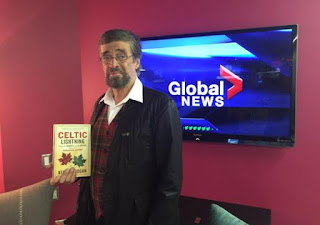
Our Hero is just some Joseph looking for love on Global TV

Our Hero is just some Joseph looking for love on Global TV


Our Hero looks a tad wary. Probably not a bad thing, given that, with the help of The Morning Show on Global TV, he was launching an air campaign. That's how I have come to think of it, the media blitz that ensues -- if you are lucky -- with the publication of a new book. The author is just some Joseph looking for a wee bit of shock and awe. The professionals at Global put together this wonderful four-minute video.  Maybe it's not shocking or awe-inspiring, but surely it marks the beginning of something? Strictly speaking, and as I may have mentioned elsewhere, Celtic Life International and Canadian Geographic fired the first salvos. But this TV appearance . . . gotta love it.  As for the ground campaign, that's when you hit the bookstores, Sharpie in hand. It's all part of the war against indifference to your book. Are we ready to grind it out? You betcha!


Read more »
Ken McGoogan
0 Comments
Before turning mainly to books about arctic exploration and Canadian history, Ken McGoogan worked for two decades as a journalist at major dailies in Toronto, Calgary, and Montreal. He teaches creative nonfiction writing through the University of Toronto and in the MFA program at King’s College in Halifax. Ken served as chair of the Public Lending Right Commission, has written recently for Canada’s History, Canadian Geographic, and Maclean’s, and sails with Adventure Canada as a resource historian. Based in Toronto, he has given talks and presentations across Canada, from Dawson City to Dartmouth, and in places as different as Edinburgh, Melbourne, and Hobart.