Theme Layout

Boxed or Wide or Framed

[style4]

Theme Translation

Display Featured Slider

No

Featured Slider Styles

Display Grid Slider

Grid Slider Styles

Display Author Bio

Display Instagram Footer

Dark or Light Style

Search This Blog

Blog Archive

Followers

Popular Posts

Pages

Showing posts with label Dead Reckoning. Show all posts
The Devil made me jive with Margaret Atwood

The Devil made me jive with Margaret Atwood


The Devil made me do it. I knew it was wrong. I knew I had no business inviting an iconic Canadian writer out onto the dance floor. I knew people would hate me for it. Who did I think I was? But a little voice told me to go ahead and ask her to dance. Graeme was there, standing tall. Sheena was there, camera in hand. 
But I'd better come clean. We had danced together at least once before, Ms. Atwood and I, at a meeting of the The Writers' Union of Canada. This was back in the day. 1985, I think it was. Things were different then.
Now it was 2011 and I had reason to be wary. We were voyaging around Scotland with Adventure Canada, having a blast, and had ended up in this community hall on the island of Jura. George Orwell had lived somewhere in this vicinity. Here on Jura, he had discerned that Big Brother was always watching. Coincidence? I thought not.
But I shrugged off all that and plunged ahead. I mention this in what you now learn is my "year-ender" because I grow skeptical about the way browsers function. My stats tell me that my all-time most popular blog post, with 17,300 viewings, is entitled A younger male writer crosses swords with Margaret Atwood. I ask you: have more than 17,000 people cast their eyes over my divigations? Or does that total derive from an algorithm that automatically counts "one" every time it chances upon "Margaret Atwood." So, yes, this is a test. That, anyway, is my story.
My other greatest hits are also all included in last year's greatest hits, which featured voyaging in the Northwest Passage, my book Dead Reckoning, and Let's Invite Scotland to Join Canada.  I remind myself that this means not that I have been less entertaining this year than last, but that "all-time" is cumulative, and so it takes more than one year to reach the upper echelons of even these modest heights.
But now I refrain from adding a second photo to this post. The Devil insists that I could justify an image of the cover of Dead Reckoning. No, I say, and stand firm. People would accuse me of being shameless and worse and that . . . that would hurt my feelings. For the rest, I would add: Merry Christmas! Happy New Year. Party on!


Read more »
Ken McGoogan
0 Comments
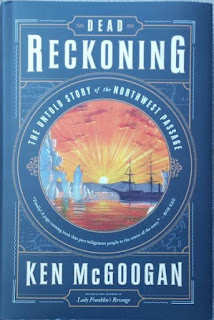
Michael Palin's Erebus and Dead Reckoning look alike because they belong together

Michael Palin's Erebus and Dead Reckoning look alike because they belong together


"What the publishing industry hath joined together let no bookseller put asunder." That's the way I see it.
Faithful readers have been nudging me: "Have you seen the cover of Erebus? Michael Palin's new book? Doesn't it remind you of the cover of Dead Reckoning: The Untold Story of the Northwest Passage?"
Well, now that you mention it, I say, yes, yes it does. It’s a perfect match. And that is as it should be. The two books complement each other. Ideally, they form part of the same whole. Erebus tells the story of a single ship. Dead Reckoning puts that story in context.  The two books should be displayed, bought, sold and read together.
When I was asked to provide a blurb for Palin’s book, I wrote: “At this late date, and against all odds, Michael Palin has found an original way to enter and explore the Royal Navy narrative of polar exploration. Palin is a superb stylist, low-key and conversational, who skillfully incorporates personal experience.”

Dead Reckoning, published in hardcover last autumn, drew an equally enthusiastic response. The paperback edition, which is now rolling into bookstores, quotes a couple of reviews on the back cover. “This book is a masterpiece, setting the standard for future works on Arctic exploration,” one reviewer wrote. “Dead Reckoning could be the best work of Canadian history this year.”
A second wrote: “Outstanding. . . . This is not the Canadian history that we learned in school.” And a third: “A sweeping work that sets out to bring the Indigenous contributors to northern exploration into the story as participants with names – not just tribal affiliations or occupations stated as ‘hunter’ or ‘my faithful interpreter.”
You get the idea. Since Palin’s book is published by Random House Canada and my own by HarperCollins Canada, I don’t think we can expect to see a boxed set any time soon. No worries. My advice would be that, when you buy the one, you should always pick up the other. Hey, just my opinion.


Read more »
Ken McGoogan
0 Comments
Frozen Dreams bring Dead Reckoning to T.O.

Frozen Dreams bring Dead Reckoning to T.O.


OK, so the photo is from Back in the Day. August 1999, to be precise. That would be me on King William Island as taken by the late Louie Kamookak. We were atop Mount Matheson on King William Island. Behind me: Rae Strait.
I'll probably mention this adventure when I give an illustrated talk called FROZEN DREAMS: Dead Reckoning in the Northwest Passage. That's going to happen in the near future at three different venues in the Toronto area. 
The talk is based on my 14th book, Dead Reckoning, which is now available in paperback. The book challenges the conventional history of Arctic exploration and highlights the contributions of fur-trade explorers and the indigenous peoples, notably the Inuit. 
In recent times, I have been visiting the Arctic almost every year, sailing as a resource historian with Adventure Canada. I am also involved in planning the 2019 Arctic Return Expedition, which will retrace the 1854 journey of explorer John Rae, who discovered the final link in the first navigable Northwest Passage. Hope to see you here or there!
Oct. 30: Arts & Letters Club
Nov. 5: Canadian Federation of University Women, Mississauga
Nov. 14: Carlton Theatre Lecture Series
Read more »
Ken McGoogan
0 Comments
Lovely paperback edition lists under $20

Lovely paperback edition lists under $20


The paperback is here! A single author's copy anyway, with countless others flowing into bookstores next week. Hats off to the folks at HarperCollins Canada! What a lovely package! This edition is slightly smaller than the hardcover . . . the perfect size!And it contains new and improved maps! And here on the back cover, a reviewer says, "This book is a masterpiece. . . . " And what is not to love about a list price under $20? OK, one cent under . . . but still! My day, no my week, is made.

Read more »
Ken McGoogan
0 Comments
Louie Kamookak discovers John Rae's cairn

Louie Kamookak discovers John Rae's cairn


The late Louie Kamookak has rightly been celebrated as a searcher for John Franklin. But more significantly, in my view, Louie was the man who discovered the cairn that explorer John Rae built in 1854, marking the final link in what would prove to be the first navigable Northwest Passage. I touched on that in Dead Reckoning, but I detailed the adventure in Fatal Passage. There, I described how in 1999, from Gjoa Haven, we set out east across Rae Strait in Louie’s twenty-foot motorboat. Quoting now:
During the thump­ing, exhilarating ride across waters so cold that a swimmer would not survive ten minutes, and in which hitting a floating log would mean almost certain death, I scribbled in my notebook, “Incredible to think that I should find not one but two fellow madmen to join me in this lunatic quest.”
Once we had established our camp on the coast of Boothia Penin­sula, our first objective was to find the cairn that Rae built. Fortunately, the explorer not only described the place where he created the marker, but also noted its geographical co-ordinates. Both Cameron Treleaven and Louie Kamookak carried Global Positioning System receivers that draw on globe-girdling satellites to specify locations and distances.
John Rae, of course, had been forced to rely on less sophisticated equipment. Because he was meticulous, his latitude reading, I believed, would be quite precise. But in the mid-1800s, the portable technology to provide accurate longitude readings had yet to be perfected. Indeed, when I checked the map, Rae’s longitude put the cairn far inland, which did not match his description of having travelled north along the coast.
Even so, we headed inland that first morning, roughly northeast, with a view to reaching Rae’s designated point and then heading west along the correct latitude so that we could not possibly miss the cairn. Under a limitless blue sky, we hiked for hour after hour across treeless, rock-strewn tundra, slogging through marshes, scrambling over ridges, and occasionally spotting caribou in the distance. A couple of times, we sighted landmarks that resembled grand cairns on the horizon, but they proved always to be giant rocks.

At about three o’clock in the afternoon, when we arrived at a broad inlet we had hoped to ford, we discovered that at best this would mean wading fifty yards through freezing, fast-flowing, groin-deep water while sinking in rock-filled mud to our knees. Treleaven insisted that we could do it, and maybe he was right. Kamookak wryly observed, “It’s too much work, this Rae stuff.” He and I voted to add a couple of miles to our hike, so instead of fording, we all three walked around.
At 4:30 p.m., we again approached Rae’s latitude, only now we were hiking north along the coast, the three of us strung out eighty yards apart, scouring the landscape. As we approached the tip of the penin­sula that Rae had named Point de la Guiche, Kamookak, who was trav­elling along a ridge, found what looked like the remains of a cairn. Instead of hollering, he simply placed his GPS receiver on the capstone, sat down, and waited for Treleaven and me to join him.
The cairn itself had been dismantled but was still clearly recogniz­able as a human creation, even with its stones covered in yellow and black lichen. Nor was it the kind of cairn, Kamookak explained, that hunters would build to cache game: the builder of this cairn had placed big rocks in the centre on top of smaller ones, a practice that would crush fresh meat. It was the only man-made structure for miles. And the GPS told us that although the longitude of this spot differed from Rae’s by three minutes and thirty-six seconds, the latitude agreed within a few yards. This was indeed Rae’s cairn.
Standing in the wind with open water visible to the west, the north­west, and the northeast, I could see the scene as it had unfolded in the wintry snowscape of early May 1854. A resolute man of forty-one, Rae had led his small party across ice and rough country for over 320 miles, man-haul­ing sledges through blizzards, gale- force winds, and temperatures as low as minus 62 degrees Fahrenheit. All the men suffered from snow-blindness, and one froze two toes. Only Rae and his two hardiest men—the Inuit William Ouligbuck, Jr., and the Cree Thomas Mistegan—reached this spot on the west coast of Boothia Peninsula. . . .
[In 2019, the Arctic Return Expedition intends to retrace Rae’s route and revisit this location.]


Read more »
Ken McGoogan
0 Comments
Dead Reckoning makes Dafoe Prize shortlist

Dead Reckoning makes Dafoe Prize shortlist


Wonderful to wake up in Melrose, Scotland, to discover that the shortlist for the 2018 John W. Dafoe Book Prize includes Dead Reckoning: The Untold Story of the Northwest Passage. 
The $10K book prize memorializes John Wesley Dafoe, one of the most significant Canadian editors of the 20th century. It celebrates non-fiction excellence about Canada, Canadians, and the Canadian nation in international affairs. In his four decades at the Manitoba Free Press, later renamed the Winnipeg Free Press, Dafoe became legendary while championing western Canadian development, free trade, and national independence. The other four shortlisted titles for the prestigious award, chosen from among thirty-eight nominees, are: Vimy: The Battle and the Legend by Tim Cook; Unbuttoned: The History of Mackenzie King’s Secret Life by Christopher Dummitt; Seven Fallen Feathers by Tanya Talaga; and The Cinderella Campaign: First Canadian Army and the Battles for the Channel Ports by Mark Zuehlke. I'm chuffed to see Dead Reckoning turn up in such company. The winner will be named later in the spring and collect the award at the J.W. Dafoe Foundation's Annual Book Prize Dinner in May.


Read more »
Ken McGoogan
0 Comments
Remembering Louie Kamookak (1959-2018)

Remembering Louie Kamookak (1959-2018)


The official obituaries I will leave to others. I feel driven to remember Louie Kamookak as my friend. Louie is well-known now as the foremost 21st-century champion of Inuit oral history – that history which, in 2014, led searchers to discover John Franklin's long-lost flagship, HMS Erebus.
For decades, Louie dedicated time and energy to collecting oral history, traditional place names, and the history of Inuit groups before Europeans arrived in the Arctic. For his contributions, he was made an honorary vice-president of the Royal Canadian Geographical Society, which awarded him the Erebus Medal. He also received the Lawrence J. Burpee Medal, the Canadian Governor General's Polar Medal, the Order of Canada, and the Order of Nunavut.
In recent months, Louie made no secret of the fact that he was back and forth to Edmonton, in and out of hospital, and receiving chemotherapy. But he was not yet sixty years old and I was in denial. I felt he would remain with us for years. A couple of months ago, Louie agreed to become Gjoa Haven Consultant on the Arctic Return Expedition slated for 2019.
Together, he and I would meet the four-person expedition at its culminating point, the John Rae Memorial Plaque and Cairn overlooking Rae Strait. By so doing, we would not only honor John Rae, but also mark the twentieth anniversary of when, together with antiquarian Cameron Treleaven, we located that site. I wrote about this in Fatal Passage and Dead Reckoning.
After camping out on Boothia and erecting the plaque beside the ruined cairn, we broke camp to return to Gjoa Haven. Louie said that, before recrossing Rae Strait, he wanted to investigate a spot where sometimes he found good hunting. So, yes, Louie had a keen interest in Arctic discovery. But he was also an Inuk living, and so helping to preserve, a traditional way of life.
Louie Kamookak was an Inuit hunter at home in this High Arctic world. In summer, he went hunting in his twenty-foot boat. In winter, he used a dog-team or a Skidoo. The water, the ice—they belonged to his world, and to the way his Inuit ancestors had lived for generations. With Louie at the wheel, away we went, south down the coast of Boothia.
We entered a nondescript bay, hauled the boat onto a sandy beach, and climbed a ridge to scan the horizon. I saw nothing. There was nothing to see. But Louie pointed and whispered: “Caribou!” A huge-antlered animal, all but invisible against the brown tundra, stood in profile more than one hundred metres away. Way too far, in my opinion. But Louie fell to one knee, brought his gun to his shoulder, and fired. Nothing happened. I thought he had missed completely.

But no! The caribou dropped down dead where it stood. I could hardly believe it. We all three went charging across the tundra. Louie was jubilant. When he reached the caribou, he cried: “Straight through the heart!” Treleaven and I watched as he skinned that dead animal, hoisted the heavy carcass up onto his shoulders, and staggered back to the boat. Heaving it into the stern, he said: “Meat will last all winter.”
We hauled the boat into deep water and set out for Gjoa Haven, returning from what had evolved into a successful caribou hunt. Louie Kamookak was feeling good. All three of us were on top of the world And as we pounded across Rae Strait in the wind, I vowed that, some day, I would put that moment on record.

[Photos: Louie at the ruined cairn in 1999. Three adventurers toast John Rae, William Ouligbuck Jr. and Thomas Mistegan. Both pix shot by tripod. Louie and me in Gjoa Haven. I asked him if he was an elder yet. He insisted that he was still too young. Photo by Sheena Fraser McGoogan.]


Read more »
Ken McGoogan
1 Comments
Bringing John Rae to Robert Burns Country

Bringing John Rae to Robert Burns Country


Next week will find me giving talks in Robert Burns Country. I mentioned previously that, thanks to a new "friendship bridge" extending between the Royal Canadian Geographical Society and the Royal Scottish Geographical Society, I have fallen heir to a whirlwind, four-day speaking tour. Now, in response to popular demand, I can provide details.
My illustrated talk is called Let's Take Back Arctic History: The John Rae Story. I argue that the orthodox or 'official' version of Arctic exploration history focuses almost exclusively on Royal Navy officers, omitting the contributions of Canada's indigenous peoples and fur-trade explorers like the peerless Scottish-Orcadian John Rae. I will draw on my books Fatal Passage and Dead Reckoning, and say a few words about the forthcoming Arctic Return Expedition, which will retrace the route Rae followed on his all-important 1854 trek. If you're in Scotland, you can catch me at 7:30 p.m. as follows. . . .
-- March 26:  Dumfries, Easterbrook Hall.
-- March 27: Galashiels, Scottish Border Campus 
-- March 28: Ayr, Council Chambers, Ayr Town Hall
-- March 29: Helensburgh, Victoria Halls

The connection with Burns is two-fold. The poet was born in a cottage in Alloway, Ayrshire (see painting to the left, which Sheena did after our first visit); and he died and lies buried in Dumfries. Somewhere, I have a photo of me in that town, sitting in his favorite chair in a local pub. But I'll dig that out another time.
[The Burns portrait derives from Alexander Nasmyth.]


Read more »
Ken McGoogan
0 Comments
View from Alaska highlights indigenous contribution to Arctic discovery

View from Alaska highlights indigenous contribution to Arctic discovery


DAVID JAMES
(Fairbanks Daily News-Miner)
Feb. 25, 2018

FAIRBANKS — For Arctic history enthusiasts, there’s never been a more exciting time. The recent findings of the two lost vessels of the Franklin Expedition, last seen sailing from Greenland in 1845 in search of the Northwest Passage, made global news. Meanwhile, historians have been producing an unending stream of books bringing us new and, in many ways, deeply revised understandings of the era. Keeping up with developments has become nearly impossible.
Thus, we’re at a good point to revisit the entire arc of this history and grapple with the new findings and what they mean, particularly in regards to Sir John Franklin and his men. This is the task Canadian author Ken McGoogan masterfully accomplishes in his newest book, “Dead Reckoning: The Untold Story of the Northwest Passage.”
McGoogan, a highly adept Arctic historian, seeks with this book to lay out the entire story of efforts of finding the Passage, from the 16th century to Roald Amundsen’s first navigation of it early in the 20th century, as well as the recovery of Franklin’s ships in the 21st.
In digging through the many nautical and overland journeys undertaken by Europeans, McGoogan explains, a common theme emerged. Native peoples, especially the Inuit, were often the heroes who saved expeditions that would otherwise have come to ruin. Of equal importance was how various explorers interacted with Natives. Those who observed and learned from the region’s inhabitants and adopted their methods generally succeeded in their efforts. Others, convinced that European technology and knowledge were inherently superior to local wisdom, often didn’t.
Martin Frobisher was the first to seek the Northwest Passage, setting out from Britain in 1576. The English merchants who financed his journey were seeking a shortcut to Asia. Over the next three centuries locating that route would be an objective pursued by many. McGoogan recounts this trip, as well as other early explorations, including that of the ill-fated Henry Hudson, namesake of Hudson Bay.
For nearly 250 years, exploration of the region was driven by the fur trade, with the search for the Passage a secondary concern. McGoogan documents the importance of Native guides and assistants who were crucial to the success of the Hudson’s Bay Company. Among them was Thanadelthur, a multilingual Chipewyan woman who served as a de facto diplomat, and Dene leader Matonabbe, who guided Samuel Hearne, the first European to reach Canada’s Arctic coast.
The British Admiralty took up the cause of discovering the Passage early in the 19th century, throwing a nearly endless supply of men and money at the objective in the following decades. In 1845, after a handful of previous attempts, the Franklin Expedition was sent forth with two modern ships, 129 men, and absolute confidence of success. They headed north of Canada and vanished. From the few bones later found it became apparent that the last survivors resorted to cannibalism in their final desperate days.
It’s here that the recent locating of the ships has drastically altered what is believed to have happened. But as McGoogan highlights, if more value had been placed on Inuit reports than on one hastily scribbled note, we would have known sooner both where the ships were and what befell the men.
The narrative that held for a century and a half was that the ships were iced in off the northwest coast of King William Island. Franklin and several others died on board. The rest abandoned the ships in 1848 and headed south, hoping to reach Hudson Bay. They starved to death before ever coming close.
This theory was based on the one written document ever found, a note detailing the plan that was recovered by Leopold McClintock in 1859. The problem is, it contradicts what Inuit in the region told searchers. They spoke of the ships moving further south, of boarding them and discovering at least one corpse, and of accidentally sinking one ship themselves in Queen Maud Gulf, southwest of King William Island.
This information was initially gathered by John Rae, who was mapping the Arctic coast in 1854 and happened upon a group of Inuit who told him these stories. They reported that at least some of the men were still alive as late as 1850, and also provided the first accounts of cannibalism.
McGoogan hails Rae as the greatest of British Arctic explorers, noting that more than any others — especially the obstinate Franklin — Rae fully embraced Native ways. He carefully learned from everyone he met along his overland travels and thrived where Franklin’s men died. Yet history turned on him. Victorian England, buoyed by Franklin’s widow Jane, refused to believe good British sailors would resort to eating each other. Rae was disgraced. McClintock was credited with learning the expedition’s fate. For the next 150 years searches for the vessels focused on where the note was found.
Then in 2014, one of the shipwrecks, the Erebus, was discovered submerged in Queen Maud Gulf. The other, the Terror, was located in Terror Bay off southwestern King William Island. They were both exactly where the Inuit had told Rae they were.
This changes the story dramatically. McGoogan writes that it’s now believed some of the survivors re-boarded the ships and made another effort at pushing through. The sailors’ demises appear to have been far more drawn out and complicated than long believed. Searches of the wrecks will hopefully shed additional light.
There is far more in this book than just a revision of the Franklin calamity. McGoogan covers numerous voyages, some well known, others largely forgotten, always with an eye on the role Natives played. Summarizing Hearne’s successful early explorations, McGoogan writes, “Europeans would be wise to apprentice themselves to the Native peoples who had lived there for centuries — a strategy that eluded many who followed.”
Most importantly, McGoogan shows how the search for the Northwest Passage isn’t just a part of European history. It’s equally a part of Inuit history. While plenty more is found here, this long overdue recognition is his book’s most significant accomplishment.
(To read as printed in the newspaper click here.)

Read more »
Ken McGoogan
0 Comments
Dead Reckoning tracks Northwest Passage through Oakville

Dead Reckoning tracks Northwest Passage through Oakville


Faithful readers (hi, Mom!) will find the above photo vaguely familiar.
That's because a flipped version turns up on the cover of Dead Reckoning: The Untold Story of the Northwest Passage. It says here that the book's author is heading for Oakville, and is not to be missed. More precisely, Our Ken will be presenting to the Canadian Club of Halton at the Oakville Conference Centre on February 22.  He tells jokes, shows slides, waves his arms -- what's not to love?
Ken's latest book challenges the conventional narrative of the Northwest Passage which emerged out of Victorian England and focuses almost exclusively on Royal Navy officers. By integrating non-British and fur-trade explorers and, above all, Canada’s indigenous peoples, Dead Reckoning drags the story of Arctic discovery into the twenty-first century.
Because Ken voyages regularly in the Passage with Adventure Canada, you never know what might pop up on the screen. Here's a cairn we chanced upon one August in Pasley Bay. 

At first I dreamed that this might be it: the cairn James Clark Ross built on Boothia Peninsula in 1831 to mark his discovery of the North Magnetic Pole. Turned out the ruins of THAT cairn lie a few hours march away. Henry Larsen built THIS cairn during his eastward voyage in the St. Roch. He did so to mark the gravesite of the ship's cook, who died aboard ship in this bay.  So that's the kind of thing might surface.

Read more »
Ken McGoogan
0 Comments
2017 Greatest Hits feature Scotland, Atwood, and the Arctic

2017 Greatest Hits feature Scotland, Atwood, and the Arctic


Last day of the year, I find myself driven out of bed at 5 am to look back at 2017, and to say hey to readers who have been checking in here. We're up over 20,000 views per month -- a far cry from pop-culture blogging numbers, but I'll take it. And I'll defer to the "overview stats" page at the back of this blog to offer up an orderly, top-five guide through the past year. . . .

And so we beat on, as F. Scott Fitzgerald wrote, like boats against the tide, borne back ceaselessly into the past . . . .


.


Read more »
Ken McGoogan
0 Comments
Beechey Island whiteout inspires Dead Reckoning video

Beechey Island whiteout inspires Dead Reckoning video


Scenes from September, voyaging Out of the Northwest Passage with Adventure Canada.

Day 8: Beechey Island
For visiting Beechey Island, the best-known historical site in the Arctic, the day was perfect: cool and overcast. We went ashore in zodiacs and climbed the rocky, snow-swept slope to the graves of the first three sailors to die during the 1845 Franklin expedition. The men perished here in 1846 and, given that Sir John was famous for his sonorous sermons, we can be sure he buried them with due ceremony. Franklin and 125 men sailed on south down Peel Sound in their two ships, the Erebus and the Terror, to meet their own fate.
On Beechey, in the 1980s, forensic scientist Owen Beattie autopsied the bodies of Franklin’s men, John Torrington, William Braine, and John Hartnell. At the gravesite, archaeologist Latonia Hartery vividly described the process. A fourth sailor was buried here in 1854 – Thomas Morgan, a man from Robert McClure’s ship, the Investigator. He had been rescued from that vessel, which was trapped in Mercy Bay on Banks Island, some distance west, but was already so sick that he did not survive.
After viewing the graves, first discovered in 1850, most passengers hiked 1.6 kilometres along the shoreline to check out Northumberland House (now a ruin). Searchers built it in 1852-53, mainly from the wreckage of an old whaler. They deposited supplies for the use of Franklin, should he return this way, and also for any later searchers. Several later memorials and markers placed here are of tangential interest.
But on the ground behind the remains of the house, we saw tin cans from the original expedition, filled with stones and lined up to form a cross. Also, we saw a wooden two-by-four etched with the name of another explorer: “J.E. Bernier / 1906.” Canadian Joseph Bernier visited here during his multi-year expedition to assert Canadian sovereignty over the entire Arctic archipelago.
Finally, here too we saw what’s usually called the Bellot monument, which features a marble slab sent from England by Lady Franklin. It was installed to the memory of the Franklin expedition by Leopold McClintock in 1857. Four years before that, while anchored nearby, Joseph-Rene Bellot had volunteered to trek north along the ice of Wellington Channel to deliver a message. He took two men. The ice broke off as they walked and they spent the night in a tent on a large ice floe. Come morning, Bellot stepped outside the tent . . . and never reappeared. Obviously, he had slipped off. The other two men waited until the floe returned to shore and jumped off to safety . . . . and sorrow.
Back on the Ocean Endeavour, Dr. Andrew Breshnehan -- always merry and bright -- gave an insightful talk on Circumpolar Health. Later, while in the Nautilus Lounge we studied an image of the Beechey Island graves, passenger Keith MacFarlane introduced a moment of silence with a moving tune on the bagpipes. And later still, a number of staffers – David Newland, Julie Bernier, Daniel Freeze, Lynn Moorman, Julie Knox, Gay Peppin, Dr. Andrew – went the extra mile to organize an unforgettable book launch for Dead Reckoning: The Untold Story of the Northwest Passage. They made the author mighty grateful.
[You can check out the dazzling, 3-minute, Beechey Island book-launch video by clicking here.]
[Pix by Sheena Fraser McGoogan]

Read more »
Ken McGoogan
0 Comments
Arctic expert Kenn Harper sings the unsung in solidarity with Dead Reckoning heroes

Arctic expert Kenn Harper sings the unsung in solidarity with Dead Reckoning heroes


Over at The Arctic Book Review, Kenn Harper begins by declaring that I have "produced yet another worthy northern book." Harper, an Arctic historian and formerly Denmark's honorary consul in Nunavut, continues: "Dead Reckoning sets out to tell, as its sub-title proclaims, “The Untold Story of the Northwest Passage.” The book is peopled with the usual suspects in the history of Arctic exploration and the search for the elusive Northwest Passage. I needn’t name them here; if you are reading this, you already know who they are. But this book introduces other names that will be unfamiliar to many readers, even some well-versed in northern history. Their stories are the “untold stories” of the sub-title. . . ."
Harper observes, rightly, that my goal "is 'to restore the unsung heroes to their rightful eminence.' [McGoogan] recognizes not just the physical work, but the contributions, of the fur-trade explorers, and of Dene, Ojibway, Cree, and especially Inuit. He points out that Franklin’s ships would still be undiscovered at the bottom of the ocean were it not for Inuit and their oral histories. And so the reader encounters unfamiliar names in this sweeping tale. McGoogan’s point is that they have largely been nameless to date, so I feel compelled to name them here, in solidarity with McGoogan’s championing of them, and to help in rectifying the injury that past histories have done them." Harper carries on at some length, and in considerable depth, as you can read here.
So, a tip of the hat to editor Russell Potter for assigning a knowledgeable, fair-minded reviewer. To Harper's questions, I offer a few answers. Yes, I included Hall's voyage to the North Pole because that yarn extended the stories of Tookoolito, Ebierbing, and Hendrik. I included the Peary-Minik story because it is the quintessential example of abusive Inuit-white relations. I omitted Kalli and Beck with a view to maintaining focus on the Northwest Passage rather than the search for Franklin. Harper correctly identifies the map-glitch that will turn some first editions of Dead Reckoning into collectors' items! He is mistaken about Moses Norton, however, who started at Prince of Wales Fort as chief factor but became governor; and Samuel Hearne, who was made governor from the get-go (1776).
Why did I make no reference to recent scholarship casting doubt on Hearne's authorship of the Bloody Falls massacre? Well, in 2007, after writing a biographical narrative about Hearne (Ancient Mariner), I undertook a foreword to a new edition of Hearne's journal (A Journey to the Northern Ocean), which tells the story of how the Dene leader Matonabbee led the former navy man to the Arctic coast of North America. After perusing the Hearne passages in Dead Silence by John Geiger and Owen Beattie, and then delving further into the archives, I ended up repudiating that scholarship. I detailed my analysis in the foreword I wrote. And I considered rehashing it in Dead Reckoning. But then I decided that doing so would take me too deeply into the eye-glazing arcane, which we are fast approaching, given that I am writing not for scholars but for a broad general audience. Too much such detail has killed many a readable book. And so I refer you to the works themselves.
Read more »
Ken McGoogan
0 Comments
Our Hero sacrifices modesty to preserve insightful review in Cyberspace

Our Hero sacrifices modesty to preserve insightful review in Cyberspace


Dead Reckoning offers lively account of Inuit contributions to discovery of Northwest Passage

Review by Charlie Smith
(Georgia Strait, Oct. 22, 2017)

Charles Dickens is deservedly seen as the greatest novelist in Victorian England. The author of such masterpieces as David Copperfield and Great Expectations was also an influential social activist, campaigning for various reforms, including an end to child labour.
In light of this, who would have thought that Dickens and the widow of explorer Sir John Franklin would have conspired to cover up one of the worst debacles in North American exploration history?
Yet that's exactly what Canadian historian Ken McGoogan has documented in his crackling new book, Dead Reckoning: The Untold Story of the Northwest Passage.
In this epic examination of the nearly 400-year struggle to find a sea route through the Arctic, McGoogan also offers page-turning portraits of several courageous and highly intelligent Cree, Dene, and especially Inuit people who are central to the story.
Indigenous giants like Matonabbee, Thanadelthur, Akaitcho, Tattanoeuck, Ouligbuck, Tookoolito, and Ebierbing—names unfamiliar to the vast majority of Canadians—take their rightful place in history alongside far more famous explorers, such as Martin Frobisher, Henry Hudson, Samuel Hearne, Franklin, and the first man who completed the Northwest Passage by sea, Norwegian Roald Amundsen.
What's so remarkable about Dead Reckoning is how McGoogan demonstrates that some of the most successful northern explorers—notably Amundsen, Scottish surgeon John Rae, and Americans Elisha Kent Kane and Charles Francis Hall—were invariably those most eager and open to learning from their Indigenous guides and translators.
Many of the English explorers on the other hand, including Franklin, tended to be less open-minded. This reflected a colonial attitude that made them less able to adapt to the harsh and unforgiving northern climate.
[Read the published version of this review, complete with pix, by clicking here.]
[Painting above: Beechey Island by Sheena Fraser McGoogan]
Dead Reckoning is an outstanding 21st-century Canadian history that refutes myths about the Franklin expedition promoted by Victorian England, its modern-day media and academic apologists, and Dickens himself.
The book's only serious shortcoming is its lack of detailed attribution because of an absence of footnotes.
According to McGoogan, one of the most crucial 19th-century developments in the discovery of the Northwest Passage was not the bumbling Franklin expedition that led to the sinking of the HMCS Erebus and Terror near King William Island in the late 1840s.
Rather, it was Rae's recognition of a small strait separating what was previously known as King William Land and the southwestern side of the Boothia Peninsula. Had Franklin's two ships taken this route rather than through Victoria Strait west of King William Island, the expedition might have reached Alaska rather than getting stuck in the ice.
More than a half-century later, Amundsen traversed this Rae Strait and later gave credit to Rae for making it possible for him to complete the Northwest Passage.
The Norwegian could do this in the early 20th century because pack ice from the north did not make Rae Strait impassable: this waterway was sheltered by the Boothia Peninsula and King William Island.
With great storytelling skills, McGoogan shows how Rae was thwarted in receiving sufficient credit for his discovery because of the machinations of Lady Jane Franklin.
Sir John Franklin's widow couldn't abide by Rae's report that members her husband's voyage ended up eating human remains.
So she summoned Dickens to tell a different tale, which generated widespread publicity and which was more in accord with the colonial mindset of the era.
"John Rae relayed Inuit testimony, as translated by William Ouligbuck, that many of Franklin's men had starved to death while trekking south, and that some of the final survivors had been driven to cannibalism," McGoogan writes. "Victorian England refused to believe this and, through Charles Dickens, suggested that the Inuit had murdered the weakened white sailors. Lady Franklin decreed that the final survivors had completed the Northwest Passage."
Dickens maintained that Franklin's men were murdered to paper over the truth. And this work of fiction by Dickens gave rise to the myth of Franklin as a great explorer and his subsequent commemoration in countless books and even in a statue in Westminster Abbey.
In fact, McGoogan demonstrates that Franklin was a rather uninspiring, sometimes blundering, seriously overweight, and hen-pecked former lieutenant-governor of Van Diemen's Land (modern-day Tasmania) who was sent back to England for incompetence.
Franklin was only appointed to head the expedition to find the Northwest Passage in the mid 1840s because of his wife's influence over the Royal family.
"In truth, Franklin discovered no Passage," McGoogan writes. "The man himself died a few months after his ships got tracked in pack ice. And when his crews marched south to seek help, they forged no link in any chain."
In many respects, the relentless and detail-oriented Lady Franklin is the villain in Dead Reckoning. But her ability to influence the British government and wealthy American Henry Grinnell to mount several expensive voyages in search of her husband actually accelerated the discovery of the Northwest Passage.
That's because these subsequent explorers, including Rae, made genuine discoveries that enabled Amundsen to successfully complete his journey in 1906.
This is not the Canadian history that we learned in school. But it is a far more nuanced and objective view of Indigenous people in North America. For that reason alone, McGoogan's book deserves wide readership in our country. But Dead Reckoning also deserves to be read because it's so enthralling.

Read more »
Ken McGoogan
0 Comments
Dead Reckoning hailed as transformative masterpiece

Dead Reckoning hailed as transformative masterpiece


By Dave Obee
Victoria Times-Colonist Oct. 15, 2017

Dead Reckoning: The Untold Story of the Northwest Passage

By Ken McGoogan
HarperCollins, 438 pp., $33.99
The Arctic is not the place it used to be; climate change is taking care of that. It is still a challenging part of Canada, but warmer weather and the relative ease of navigation are opening up a region that contains some of this country’s greatest mysteries.
For more than a century and a half, many of those mysteries have had to do with Sir John Franklin, who led an ill-fated expedition into the Arctic in the 1840s, seeking the Northwest Passage to the Orient.
Franklin, all of his men and his ships disappeared — but over time, more and more evidence has been found, and with that, more has been determined about the fate of the Franklin expedition.
The two greatest discoveries are quite new. One of Franklin’s ships, Erebus, was discovered in 2014, and the other, Terror, was found in 2016. These two ships represent true sunken treasures, because the relics they contain — possibly including human remains — might answer many remaining questions about Arctic exploration.
That’s not the only difference. Today, there is a greater awareness of Indigenous involvement in the exploration and rescue missions. There is an acknowledgment that without the help of those who lived in the area, many more people would have died, and many of the Franklin mysteries would never have been solved.
Put it all together and the history of northern exploration needs to be rewritten. Books done a decade or more ago are out of date. As history is revealed, reshaped and reconsidered, we need a fresh assessment of Franklin and the other early adventurers, including the First Peoples who made it all possible.
Ken McGoogan’s Dead Reckoning helps fill that need. This book is a masterpiece, setting the standard for future works on Arctic exploration.
This is McGoogan’s fifth book on the Arctic and the explorers and adventurers who challenged that icy world. In Dead Reckoning, he draws from his past work, but weaves it all together in a more complex but highly readable account, enhanced with fresh insight based on the new discoveries as well as more extensive research.
For years, the conventional narrative of the Arctic has been based on names such as Franklin, Parry, McClure, Ross and Peary. McGoogan goes deeper into the story, introducing us to such figures as Thanadelthur, Akaitcho, Tattenoeuck, Ebierbing, Tulugaq and Tookoolito.
Some Inuit saw living members of the Franklin expedition, and others later found their bodies. They provided information to search parties led by Charles Francis Hall and Frederick Schwatka that helped them uncover crucial clues about the fate of the Franklin party. More recently, information from the Inuit helped drive the discovery of the two ships.
There are heroes and villains here, with Lady Franklin, Sir John’s widow, at the top of the list of antagonists. She pushed her husband to embark on his final expedition, and she led the way (with Charles Dickens) in dismissing the revelations of John Rae, and in denigrating his Inuit informants.
The end result could best be described as politics. Franklin’s fate became a matter of great controversy in England, with plenty of misinformation tossed this way and that. McGoogan deals with it in detail.
Over the years, many books have been written on the far north — but with the publication of Dead Reckoning, those early ones don’t matter the way they once did.
There is little to criticize in this book. It should be the starting point when considering the story of Arctic exploration from the 16th century onwards.
Beyond that, Dead Reckoning could be the best work of Canadian history this year.
Ken McGoogan will be in Victoria on Tuesday for a reading at Bolen Books in the Hillside shopping centre. The event will begin at 7 p.m.
The reviewer is the editor-in-chief of the Times Colonist.
Read more »
Ken McGoogan
0 Comments
Dead Reckoning inspires first-ever book launch at Beechey Island

Dead Reckoning inspires first-ever book launch at Beechey Island


First came the book launch at Beechey Island. We were sailing through the Northwest Passage with Adventure Canada when, thanks to a myriad of volunteers, the party just erupted. OK, we didn't party ON the island, site of the graves of the first three men to die on the 1845 Franklin expedition. That would have been disrespectful. But on video, we caught bits and pieces of both the island and the event, as you can see here. And I will go out on a limb and suggest that this Dead Reckoning extravaganza was the first-ever book launch at Beechey. We brought aboard 65 copies of the book and presto! they were gone! This is not J.R. Rowling territory, but I've made my peace with that. Now, tonight, comes the downtown Toronto launch at beautiful Ben McNally Books. It's not a first, and won't be a last, but me, I'm looking forward to it.


Read more »
Ken McGoogan
0 Comments
Here's why we're excited to visit the site of Franklin's found Erebus

Here's why we're excited to visit the site of Franklin's found Erebus


Parks Canada divers will resume exploring Erebus a few days from now, around the time we reach the site with Adventure Canada. That's the word on the street. Thanks to Parks Canada, we will have a live feed that will enable us to witness discoveries as they happen. Why is this exciting? Well, I offer an excerpt from my forthcoming book, Dead Reckoning: The Untold Story of the Northwest Passage. . . .

The other ship (Erebus) was carried south by ice to Wilmot and Crampton Bay, an area known to the Inuit as Oot-joo-lik. [Researcher] David Woodman suggested that a large group of sailors abandoned that vessel in 1851, while it drifted south in the ice. Some Inuit hunters met this party of men, weak and starving, slogging south along the west coast of King William Island. These were the men In-nook-poo-zhe-jook described to John Rae. A few sailors—probably four, according to Puhtoorak—remained aboard the ice-locked ship, probably until early 1852.
This is not the place for a forty-page analysis of Inuit oral history. But the discoveries of the ships does suggest turning a spotlight on a few key passages that explain why most Franklin aficionados believe archaeologists will discover at least one body aboard the Erebus. Not far from where Canadian searchers found the ship, Charles Francis Hall and Tookoolito interviewed a local woman named Koo-nik. She was the one who spoke of finding “a very large white man” dead on the floor inside a ship.
In a letter to his sponsor, Henry Grinnell, Hall added details: “The party on getting aboard tried to find out if any one was there, and not seeing or hearing any one, began ransacking the ship. To get into the igloo (cabin), they knocked a hole through because it was locked. They found there a dead man, whose body was very large and heavy, his teeth very long. It took five men to lift this giant Kabloona [Qallunaat or white man]. He was left where they found him. One place in the ship, where a great many things were found, was very dark; they had to find things there by feeling around. Guns were there and a great many very good buckets and boxes. On my asking if they saw anything to eat on board, the reply was there was meat and tood-noo [caribou fat] in cans, the meat fat and like pemmican. The sails, rigging, and boats—everything about the ship—was in complete order.”
This same story turns up again in 1879, when with the help of Ebierbing, Frederick Schwatka interviewed Puhtoorak, one of the Inuit who had ventured aboard the Erebus. Puhtoorak said that he found a dead white man in a large ship eight miles (thirteen kilometres) off Grant Point (near where Erebus was found). He reported that the Inuit found a small boat on the mainland, and many empty casks on the ship. “He also saw books on board the ship but did not take them.”
Puhtoorak also said that before discovering the ship, while hunting along the shore with friends, he came across the tracks of four white men and “judged they were hunting for deer.” Later, he found the tracks of three men, and suggested “that the white men lived in this ship until the fall and then moved onto the mainland.” In so saying, he affirmed the earlier account by Koo-nik, who told Hall that Inuit had seen “the tracks of 3 men Kob-loo-nas & those of a dog with them.” Hall added that “there is no such thing as their being mistaken when they come across strange tracks & pronounce them not to be Innuits.”
These accounts and others, taken together, suggest that four men were living aboard the Erebus when the ice carried it—some suggest they guided it—into Wilmot and Crampton Bay. One of them¾a large man?¾probably died on board. The other three left the ship in a bid to survive, and were never seen again. Inuit hunters boarded the ship. They made off with a few “treasures” but left a great many more.

Over the next few years, Parks Canada archaeologists will almost certainly produce artifacts and possibly papers that will further clarify what happened to the Franklin expedition. Inuit testimony suggests that they will come across at least one body in Erebus. . . . If the past is any guide, these findings will generate conflicting interpretations. This much is certain: as experts thrash out an all-encompassing revision, they will draw heavily on Inuit testimony. 
Read more »
Ken McGoogan
1 Comments
Before turning mainly to books about arctic exploration and Canadian history, Ken McGoogan worked for two decades as a journalist at major dailies in Toronto, Calgary, and Montreal. He teaches creative nonfiction writing through the University of Toronto and in the MFA program at King’s College in Halifax. Ken served as chair of the Public Lending Right Commission, has written recently for Canada’s History, Canadian Geographic, and Maclean’s, and sails with Adventure Canada as a resource historian. Based in Toronto, he has given talks and presentations across Canada, from Dawson City to Dartmouth, and in places as different as Edinburgh, Melbourne, and Hobart.